I’ve had some requests recently for sewing basics so today I’d like to discuss how to sew a gathering stitch. Learning how to gather fabric is a basic sewing technique, and essential for garment sewing, but it can be challenging when you are first learning.
I would LOVE IT if you would take a few minutes to leave a comment with any sewing basics that you’d like to see here on the blog. It will obviously take some time to create a good pool of basics, but it will help to know what your interests are!
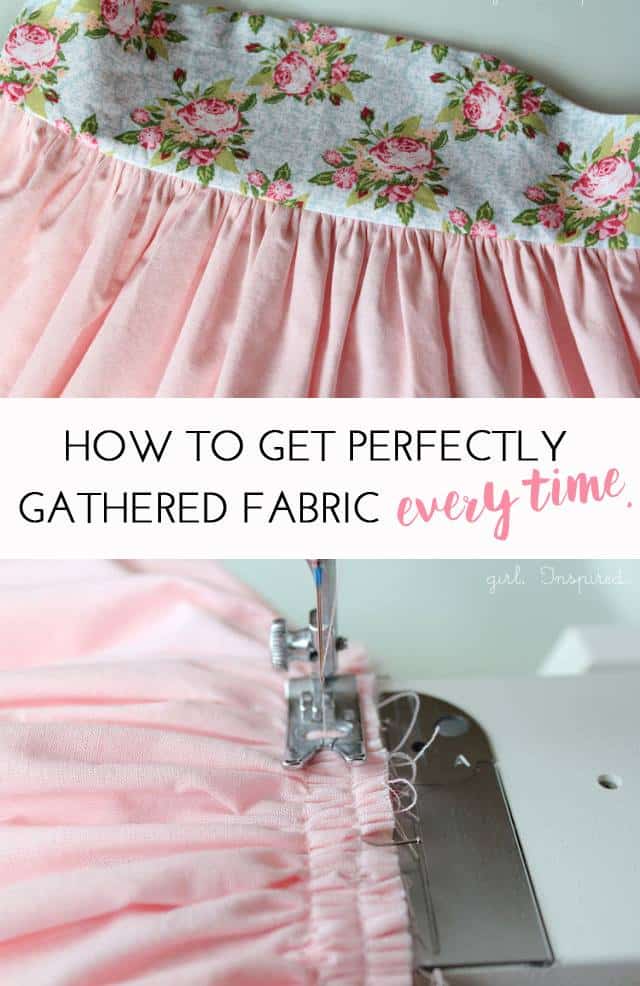
Clearly, I like a lot of ruffling to accompany “my style.” And while it may be old hat to many of you, gathering and stitching fabric can be an intimidating process for others – I know it definitely was for me when I started sewing garments! I’m going to show you the process of gathering a skirt to join it to a bodice that will give you the cleanest results with (hopefully!) the least amount of frustration and/or mess. The trick is this: sew two lines of gathering stitches, press and steam your gathers, and pin a lot!! Incorporate those three things and you’ll be good! Ready?
Prepare your skirt pieces so that they’re ready to attach to the bodice. First, you’ll sew two parallel rows of long (gathering) stitches around the top of the skirt. (Stitch length long, tension loose.)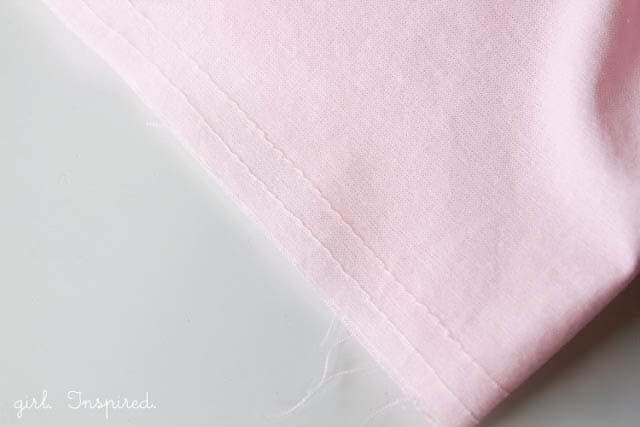
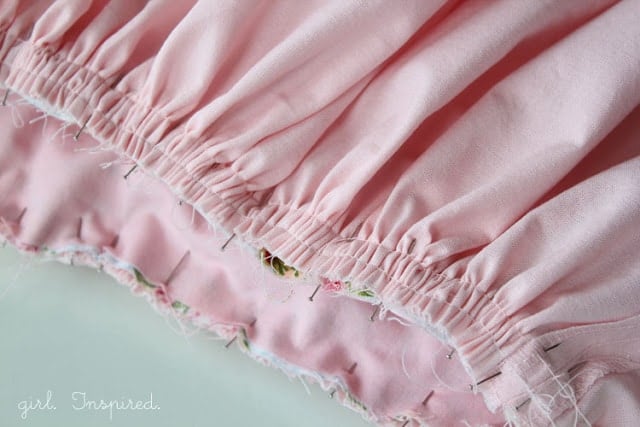
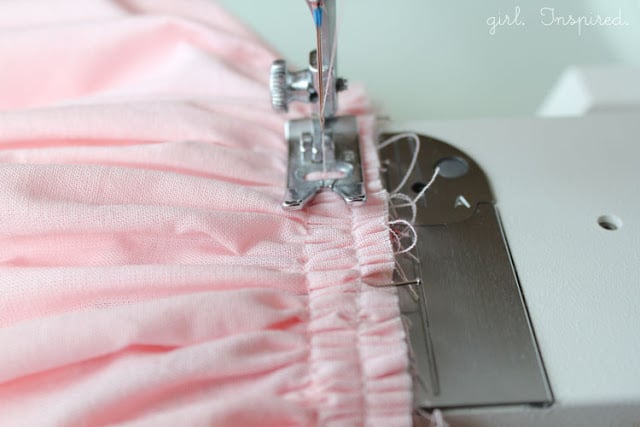
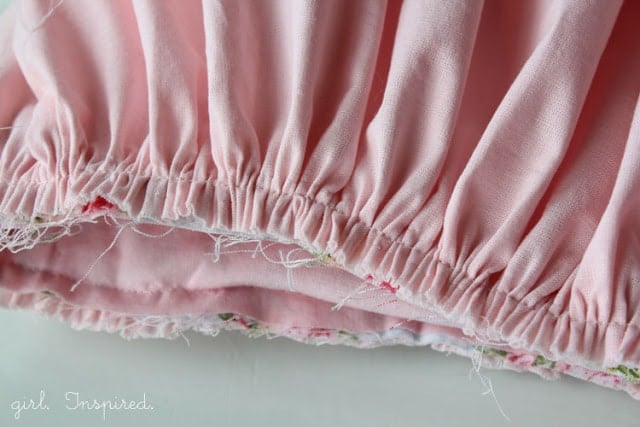
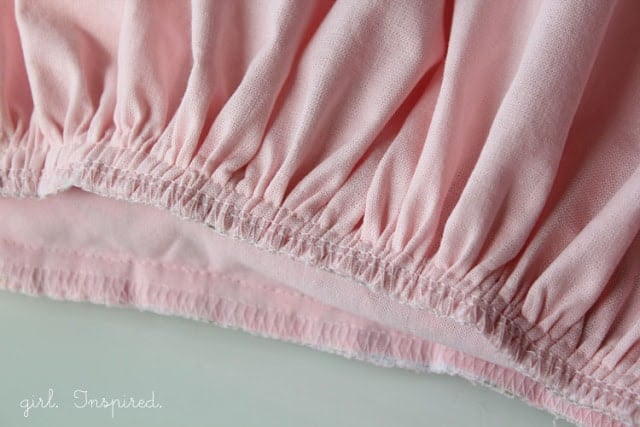
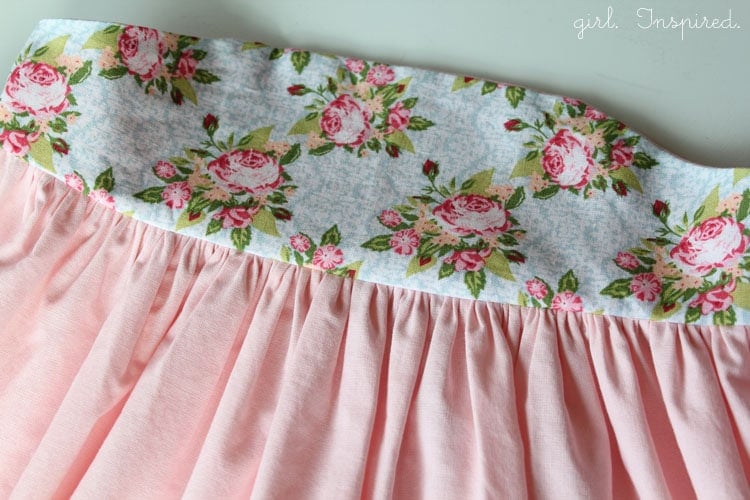
Use this gathering technique for perfect ruffles added to anything! It’s not necessarily limited to attaching a gathered skirt to bodice. You would use this technique if you’re gathering a skirt to add it to a waistband or to add a ruffle to the bottom of your garment.
SO!! Is this how you do a gathering stitch?? Is this Sewing Basics tutorial helpful? What other Sewing Basics would you like to see on the Girl. Inspired. blog??
Popular Sewing Basics & Tutorials
You might also enjoy these other sewing basics and project ideas!











Comments & Reviews
Anonymous says
Thanks for sharing, this is a great tutorial. Alyssa
Anonymous says
Hi! I would love to see a tutorial on how to finish seams/raw edges without a serger by both sewing and finishing with ribbon or bias tape. Thank you for sharing your knowledge.
kristin says
Great tips, Stef! Especially loved the steam recommendation (and used it this weekend!). I usually gather this way too; sometimes using the “cheater” method of increasing tension and stitch length and just sewing one line that gathers on its own, especially for small sections of fabric.
Chrissy says
Thank you so much for the basics! I have done many ruffles but it is always great to be reminded of the correct technique from the master!!!
Stef says
I don’t know about master, but thank you for the sweet comment!
Paula says
OK I need really basic info…lol, I actually know how to do this gathering…which is quite funny to me that I can do something sort of advanced (in my book anyway ) but, I CANNOT manage to keep a sewing machine running for long because I always mess up the tension somehow…My mom just shakes her head and walks away saying, “I don’t know what you did”… while I exclaim “I never touched the tension thingy!”
Help!
Stef says
Thanks for sharing this Paula! It made me giggle. Sometimes it helps to have someone looking over your shoulder when you’re having a hard time with your machine. I wonder if a plate or part is loose in your sewing machine if the tension is changing without you touching it? Maybe carry your machine in to a professional for a glance over?
Ellen says
I get even lazier sometimes and yse a machine foot that gathers the fabric and attaches ut to the other fabric at the same time. Not the big really strange contraptions of earlier years, but a small flat foot where you guide two fabrics through.
The gathers are based in the length ofof the stitch you select (I made samples to keep in hand fir reference). Most sewing machine makers have this foot to purchsse.
Those older contraptions tend to make more of a flat gather that look like pleats than real gathers.
Ellen says
how do you keep the weights from shifting when cutting ?
I put a pin in each corner and if the piece is long another pin in each long side in the middle if the length.
Ellen says
I’ve learned the hard way not to mess with my tension (my newest machine dies it all by itself).
If your tension is that messed up, its time to take it to the shop for a tune up. Well worth the $, once a year as it also gets super cleaned up inside in places you can’t get to.
Motherglads says
My very first machine was like that. It was 1957 and I had just bought a Kenmore machine. For years I spent hours adjusting the tension. Finally, in 1972, I learned it was a faulty tension control and bought a new machine. No more trouble. It is now 2016 and two machines later I still have no tension problems.
twiggynest says
I absolutely adore ruffles and try to add them to my projects when they suit. This is the best tutorial I’ve read! PS. Your blog is my favourite, I read a lot of blogs but get a thrill when I see your latest post pop up in my inbox, Thankyou!
Clever Blonde -Donna G says
Thank you for sharing this tutorial. I sometimes just use pins to gather. Marking and matching beginning, end, middle and also 1/4 marks and then go round manually spacing it out as I pin. I do use this method of sewing 2 gathering lines also but I then gather and pin to other piece of fabric. I can see this method of sewing the gathers in place before attaching the other piece of fabric will make it much, much easier to work with. I’m looking forward to the chance to try this method. Thx
Stef says
In this example, I did gather and then pin to the bodice piece before sewing the gathers down. BUT, when I use my ruffling foot to gather a ruffle that doesn’t need precise finished measurements, I definitely gather it separate from attaching it to the other piece of fabric and it does make it SO much easier!
Jessica says
I’m not sure I understand why to double stitch. I usually only do one (but I’m very new). Do I use both to gather or just one?
Clever Blonde -Donna G says
Hi Jessica, you use both rows of stitching. The theory is that by doing two rows you will get neater and more even gathers. I also think it helps spread the load of the fabric so there is less tension on each strand of gathering thread.
Mae says
so glad I finally learned the reasoning behind the two stitch gather. I at times will do two and others be lazy and just do one. I hadn’t steamed along the way, which is probably why mine were not as clean as I’d liked. Thanks again for pointing out these basics. Even after years of sewing I can better my basics. 🙂
Stef says
Thanks, Clever Blonde!! Using two stitches isn’t mandatory, but it sure does gather everything much neater. I also agree that the double row of stitches is much more durable when you’re pulling up the threads to gather! Of course, I get lazy sometimes and skip the second row of stitches, but I usually end up kicking myself because it makes more work in the next step.
Falafel and the Bee says
Oh I love this idea! Can you tell me if you have any tips on attaching sleeves to a lined bodice so the seams are covered?
~Michelle
Vanessa@Designs By Sessa says
I don’t get to sew little dresses much, but I am very thankful for the steam tip! I did not know that helped! Thanks!
SpringsAcres says
Thanks for the tips! I think I’m going to have to go sew my daughter yet another skirt now to make sure I have the technique right. 😉
Charity says
Thanks for the tips! I also do two lines of stitching and lots of pins, but I don’t think I’ve ever steamed my ruffles. I’m going to try it, I think it’ll make things much easier for me. =)
treen says
Ah ha! So that’s what I’ve been doing wrong! I do the double line of stitching to gather in the first place, but I’ve been sewing the main seam on one side of both lines rather than between them and not pulling the gathering threads when I’m done. This should clean up my lines a lot. Thanks!
Rachel Allen says
Great tips! Thanks! Any good tips or short cuts on cutting patterns? It seems like it always takes so long & I just want to get the show on the road.
samanthasmom says
Pattern weights for the big pieces. I still like to pin the small pieces, but a good set of pattern weights cuts the time down. And a rotary cutter for the long straight pieces.
jana giraud says
Rachel, there is a product called fabric Stick. It’s in a small can I found it at Joanns. It works great and all you do is spray it on your pattern piece and lay it on your fabric. No more pinning and you don’t have to worry about folding it up on its self to put back into the envelope. Comes apart easily. I love the stuff.
Azsuntea says
A good pair of sewing scissors is essential
Bratling says
You forgot one thing, hon. You’ve gotta anchor the stitching at the beginning of the gathering or it’ll just pull out. So with normal tension, go forward, back, and forward before turning down the tension. Three lines of gathering are awesome, too, if you’ve got a *really* full skirt. I also tend to do it in panels. So I gather the front, and then the back instead of over the seams.
Charity says
I don’t anchor the stitching at the beginning of my gathers because I like to be able to gather it from both sides… I just temporarily wrap the threads in a figure 8 around a pin so they won’t pull out. Three lines of gathering helps on shifty or thick fabrics too. =)
Sharon F says
This is how I anchor the threads too.
Sandra says
Hi. Im a self taught sewer. Have found this helpful. I often try n skip the iron but yes girls, ironing is essential for great results.
Thanks for the basics , glad of the simple help. Hard to find.
S.l.
Sewlady says
That is what I do. Then you can unwrap and adjust.
LA says
That’s how I anchor mine too with pins and do the figure eight . Works great.
Stef says
I also don’t anchor the stitching – I just make sure to leave long (inches or so) tails at the beginning and end of my row of stitching so that there’s no chance they’ll pull out before I can get everything gathered up! Thanks for the tip on three lines of gathering – I’ll have to try that!
Jeanie says
Great tutorial ! This post is old but I just ran across it – thanks to Pinteest ! Have you tried the 3 rows for gathering yet? I have done this for years and it works great. I sew the two threads like you do then I go back and follow the bottom row of stitching but move my needle position outside of the 5/8″ seam line. Yes, the thread will show once you have sewn your seam so this wont work on fabrics that leave needle marks but for all other fabrics it will hold the gathers flat while you sew. Once finished simply remove the third row of stitching. I do leave the third row if I need to ‘stitch in the ditch’, then remove it. It just helps me lay in gathers without having any of the fabric kick up and get in my stitching seam.
Nenita C. says
This is not exactly a comment but a question how about if I want to make a bed skirt ?
girlinspired says
Hi Nenita – well, if you wanted to make a bed skirt, you would essentially gather the same way. You’d piece together the skirt sections and then gather, gather, gather. Same concept, just a lot more gathering. 🙂
Sewlady says
Use crochet cotton and zigzag over the thread. Hold the thread up as you sew and it won’t catch the cord.
Carolyn says
yes that is what I have been doing for years.. 3 rows one outside of seam allowance. gather stitch to bodice then remove third row. perfect gathers.
Judy P says
I don’t anchor mine either, how ever I do leave a long thread at the beginning of my stitches and then take both of the and wrap them in a figure 8 pattern around one of my pins. Makes it stable and yet easy to remove when I’m done.
Deborah says
I started sewing when I was 8 yrs. old and always struggled with this.It would seem to take forever.I’m in my late 50’s and I GUESS you can teach an OLD DOG new TRICKS. I LOVE this idea nd can’t wait to try it. THANKS.
Tina Butcher says
When I began sewing I used the two thread method for gathering. While it works great if you are easing a sleeve onto a bodice I discovered years ago that if you use 50 lb test monofilament fishing line you never have to worry thst your threads will break in the middle of a large project. You simply lay the fishing line on your fabric and zig zag over top
If the fishing line. When you finish you can pull the line to gather your fabric. It’s much quicker. Less frustrating.
Bonnie Cuddihy says
I do exactly the same for gathered bedskirts. It’s a lot heavier fabric and the fishing line is much more manageable.
Shannen s says
Exactly the information ive been looking to find .. i appreciate that you really play-by-played every step thats what i needed! Thank you!